See what every number on your report actually means for you — your age, your sex, what you’re trying to fix — and whether the supplements you take are doing anything about it. Every answer shows where it came from, and when it was said.
What you get

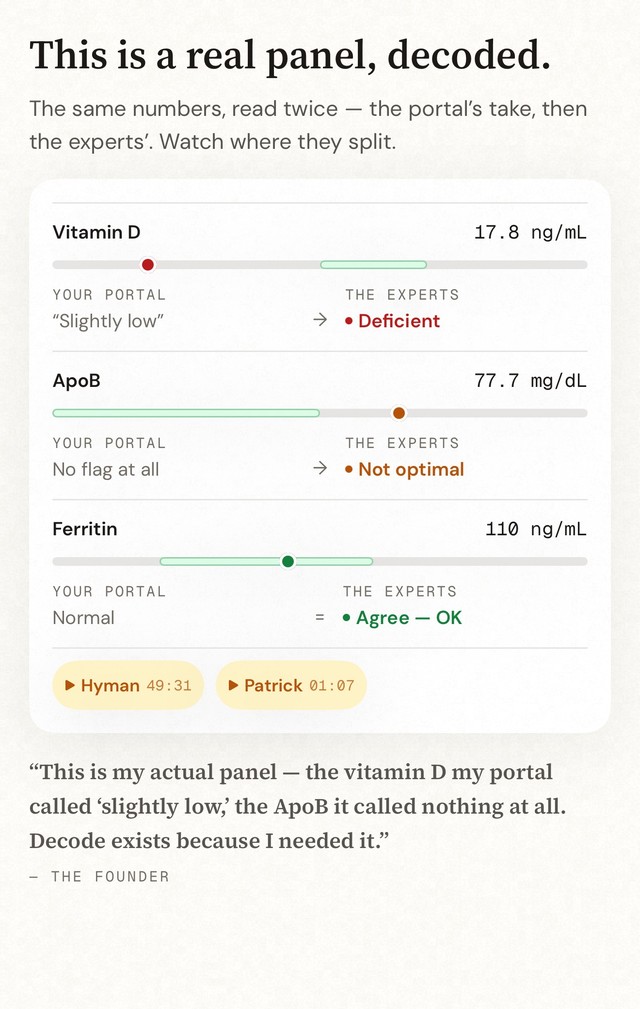
What each number actually means for you — not just whether it got flagged. Add it as a photo, a PDF, or straight from Apple Health.

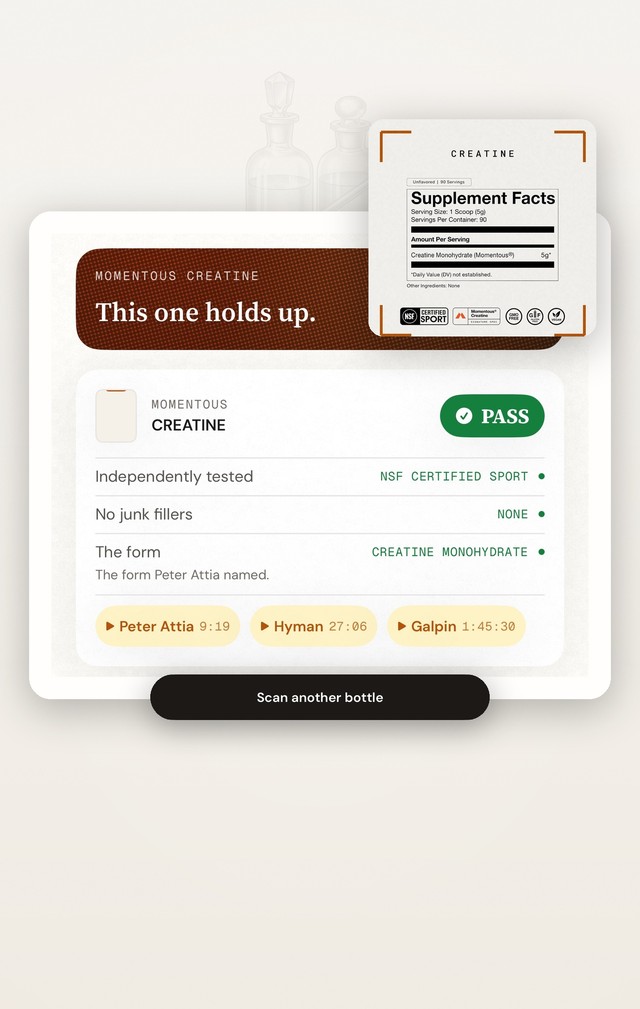
Point the camera at a supplement. Has anyone independent actually tested it? Is it the form the experts name? Does the dose fit your numbers?

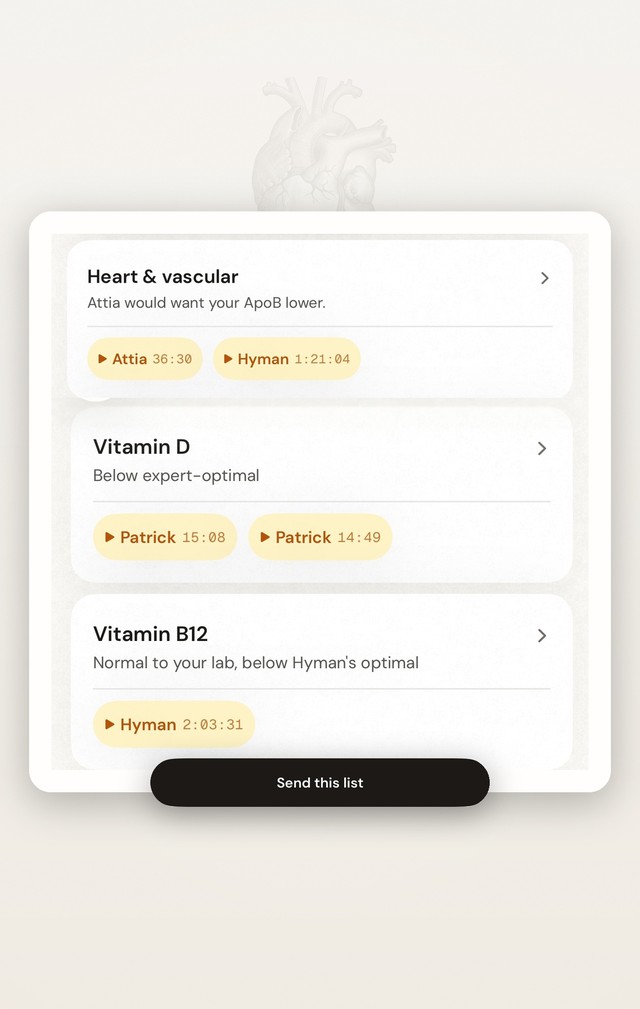
Most panels stop at the basics. ApoB, vitamin D, B12 — the ones the research says to add for you. Send the list straight to your doctor.

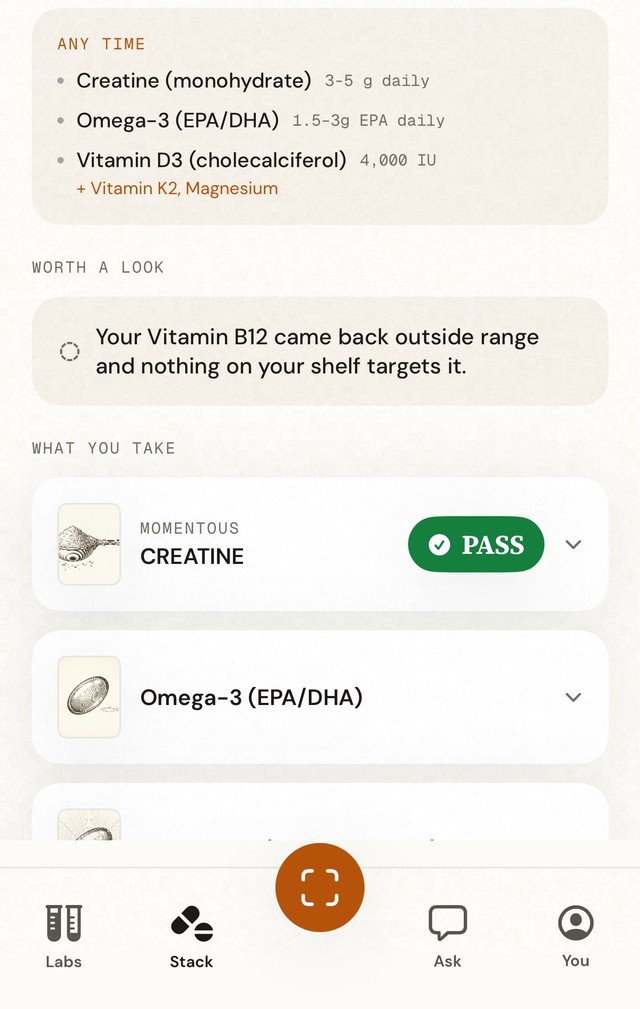
What holds up, what your numbers say is missing, and what to take when.
From a real report
That’s TSH — the signal your brain sends your thyroid. This lab doesn’t flag a high TSH until 4.12, so 2.49 comes back clean and nobody mentions it again. Attia is the only one on tape who has named his own target. He does it twice:
“you want to see your TSH kind of below 2 ish and that tells you that your brain is adequately seeing t4 converted into t3”
DR. PETER ATTIA ▸ 4:45 AND AGAIN ▸ 7:42
The old way
This one holds up.
HYMAN ▸ 27:06GALPIN ▸ 1:45:30ATTIA ▸ 9:19
Seconds, not an evening — with the names attached.
How it works
A photo of the printout, the PDF from your lab’s portal, or Apple Health. Any lab, any format.
The few results worth your attention, set to your age and sex, with the evidence sitting under each one.
The gaps your own results point to, in one day plan with the dose and the timing on every line.
Before a supplement goes in the basket: does it hold up, at your dose, for your numbers.
Ask anything
My magnesium is normal but my vitamin D is low. Do I still need magnesium?
A normal result doesn’t settle it. A serum test reflects under 1% of the magnesium in you — Rhonda Patrick’s point is that your body pulls from bone to hold that number steady, so a real shortfall can hide behind a clean report. She also says magnesium is what converts vitamin D into the form your body can use.
Dr. Rhonda Patrick ▸ 9:30
When do I take them?
Magnesium in the evening, 30 to 60 minutes before sleep. Vitamin D with any meal that has fat in it — it’s fat-soluble, so without fat you absorb very little of what you swallow. For vitamin D the hour doesn’t matter; the fat does.
Dr. Andrew Huberman ▸ 1:16:01Dr. Mark Hyman ▸ 0:44
Every answer opens the video at the second it was said, searched from 4,578 timestamped videos across 12 channels.
It only tells you what someone actually said.
Not a doctor, and never a diagnosis.