Iron: do you need it, and which one?
Checked 25 October 2026 · labels from NIH's public label database, January 2026 release
The short answer
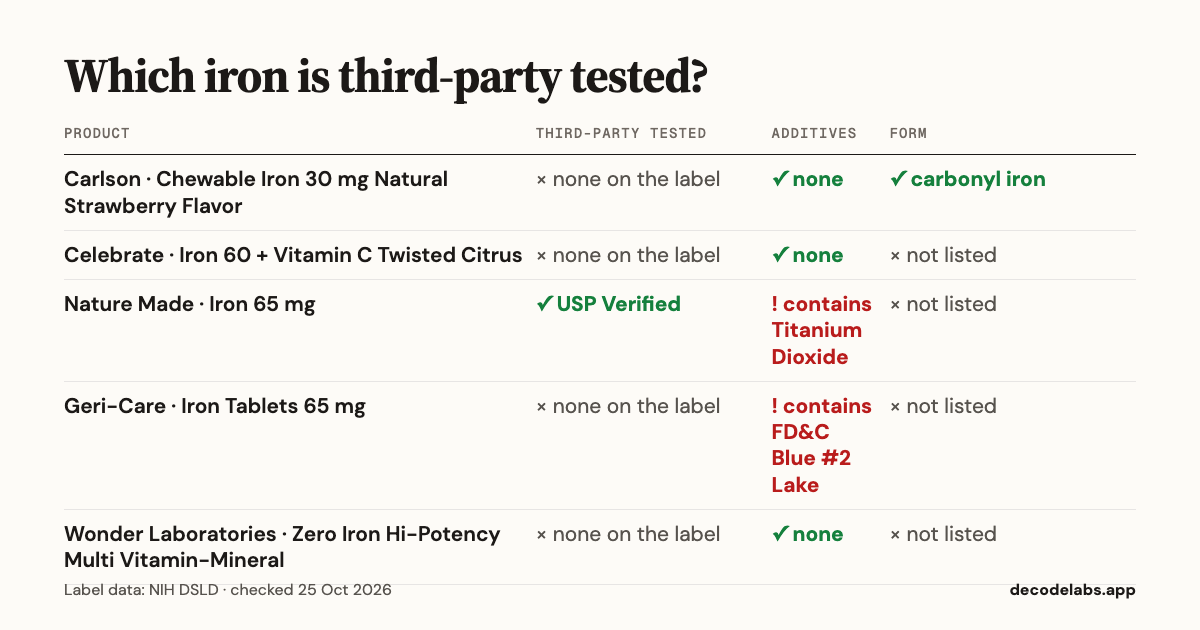
NIH lists 469 iron labels on the US market, which make up 459 products. Only 14 of those products are third-party tested: an outside lab's seal on the label, or the product's name on that lab's own list.
2 of them pass all three checks: third-party tested, none of the additives we check for, and a form an expert we quote prefers.
Source: NIH's public label database, 11 January 2026 release; checks by Decode, 25 October 2026
From every label to the ones that pass
- Iron products on the US market (NIH) 459
- Third-party tested 14
- …and none of the additives we check for 8
- …and a form an expert we quote prefers 2
Source: NIH's public label database, 11 January 2026 release; checks by Decode, 25 October 2026
Do you need iron?
Start with your blood test. The number to look at is your Ferritin.
What was said about that number:
“…if your your level's under 45 it's going to affect your health even though the reference range on the lab says 16 or above is normal 45 or above should be the normal range or the optimal range”
“Not the optimum level that you I might think is good like vitamin D over 45 or feritin iron store over 45”
“…ferritin is the marker of iron stores in the body and we want that ferritin in general to be you know around 50 to 70 you don't want it to be too high because that's not good”
“…every female who is premenopausal should be getting their ferritin levels checked ferritin is your storage form of iron and if your ferritin levels are below 30 nanograms per deciliter this means that you don't have enough iron to optimally function your mitochondria and produce hormones like melatonin”
“…so a ferritin level of less than 30 is actually not deficient it doesn't mean that you have a frank anemia but you still might not be functioning optimally”
Which iron products pass all three checks?
Third-party tested, none of the additives we check for, and a form an expert we quote prefers. Sizes of one product are shown once.
-
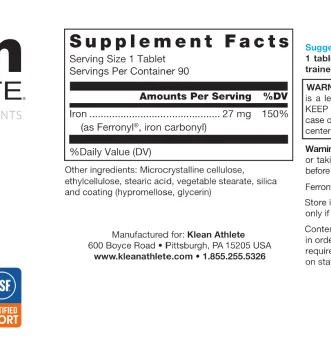
Image: NIH label database Klean Iron
 Third-party tested: NSF Certified for Sport
- None of the additives we check for
- Form: Ferronyl carbonyl iron
An expert prefers this form See the quote
-
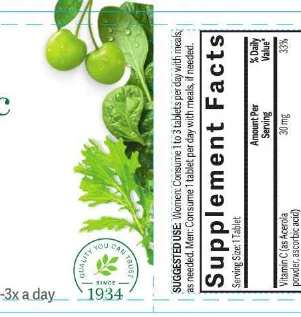
Image: NIH label database Iron Folic
- Third-party tested: NSF
- None of the additives we check for
- Form: Carbonyl iron
An expert prefers this form See the quote
What was said about each form of iron
Carbonyl iron named as preferred
“It's supplementing every other day with a very high bioavailable iron. And when we start looking at how we are supplementing every other day with either carbonyl or glycinate, then we're really able to boost that ferotin and people start to feel better”
Iron glycinate named as preferred
“It's supplementing every other day with a very high bioavailable iron. And when we start looking at how we are supplementing every other day with either carbonyl or glycinate, then we're really able to boost that ferotin and people start to feel better”
Brands that make iron
- Nature Made8 of 10 third-party tested
- Equaline2 of 2 third-party tested
- Colorado Biolabs1 of 4 third-party tested
- Klean Athlete1 of 1 third-party tested
- Nutrilite1 of 1 third-party tested
- Sunmark1 of 1 third-party tested
- Carlson0 of 10 third-party tested
- MusclePharm0 of 5 third-party tested
- NOW0 of 5 third-party tested
- Integrative Therapeutics0 of 4 third-party tested
- Nature's Bounty0 of 4 third-party tested
- up&up0 of 4 third-party tested
- Garden of Life0 of 3 third-party tested
- Nutricost0 of 3 third-party tested
- Bluebonnet0 of 2 third-party tested
- GNC0 of 2 third-party tested
- Member's Mark0 of 2 third-party tested
- Natural Factors0 of 2 third-party tested
- New Chapter0 of 2 third-party tested
- Walgreens0 of 2 third-party tested
- DaVinci Laboratories0 of 1 third-party tested
- Life Extension0 of 1 third-party tested
- Natrol0 of 1 third-party tested
- Protocol For Life Balance0 of 1 third-party tested
- Shaklee0 of 1 third-party tested
- XYMOGEN0 of 1 third-party tested
NIH lists 225 brands that make iron. This list shows each brand with a third-party tested product, plus each brand with its own page here.
Source: NIH's public label database, 11 January 2026 release; checks by Decode, 25 October 2026
Common questions
What counts as third-party tested?
A seal from an outside lab that tests what is inside, such as USP Verified or NSF Certified for Sport, or the product's name on that lab's own list, such as IFOS for fish oil. A badge about sourcing, diet or the factory does not count, because it does not test what is inside.
Does no seal mean a product failed a test?
No. It means the label shows no third-party test, and no testing lab's list we read (BSCG, IFOS, IGEN, IKOS, Informed Choice, Informed Sport) names the product. A brand can test privately. This page shows what the label and the lists show.
Which iron should I take?
That depends on your blood test. This page shows the label checks anyone can see.
Where does the label data come from?
The NIH Dietary Supplement Label Database, which is public domain. We read the file dated 11 January 2026. Brands change labels, so check the one you have.
Our method
- Third-party tested
- A seal from an outside lab that tests what is inside, printed on the label, or the product's name on that lab's own list.
- Additives
- Each other ingredient on the label, checked for artificial coloring, titanium dioxide, hydrogenated oil and BHA/BHT preservative, after a physician spoke against dyes, fillers and preservatives on video.
“…that are at the right Doses and that are effective and that don't have a lot of additives and fillers and preservatives and chemicals and dyes”
- Form
- The form printed on the label. When an expert we quote has talked about that form, the speech bubble next to it says where they stand. Open it to see what they said.
- One product, many labels
- Label versions that share a UPC count as one product. The newest label is the one shown.
- Dose
- The amount is shown as printed. Whether it suits you depends on your blood test.